

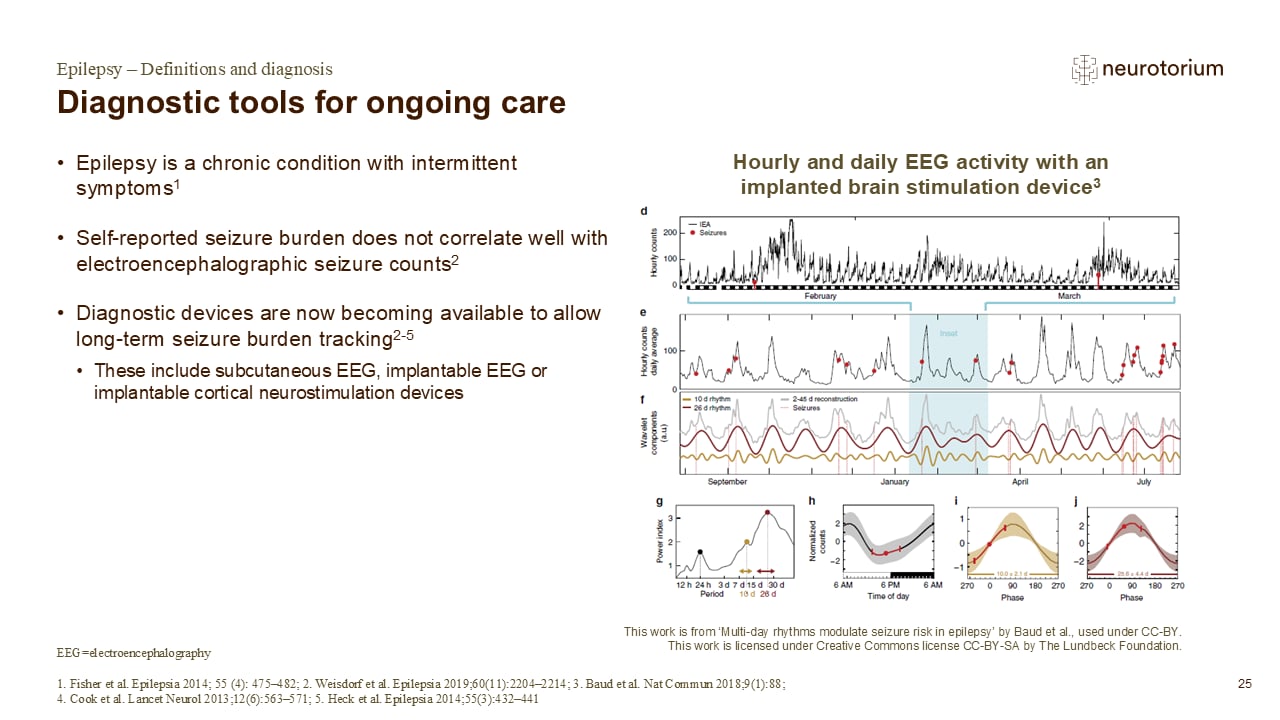
In one study, nine adults with epilepsy and known or suspected temporal/frontotemporal seizure foci and self-reported seizure frequency of at least one seizure per month had a subcutaneous EEG device implanted to enable continuous at-home monitoring and were provided with electronic or paper diaries to record any seizures that occurred.2 A total of 491 days of EEG recordings were collected.2 There were often mismatches between the number of seizures reported by participants and those recorded on EEG – two participants had many electroencephalographic seizures without corresponding diary entries, and the reverse was true for another two participants.2 There was only complete agreement between diary entries and EEG activity for one participant.2
References:
1. Fisher RS, Acevedo C, Arzimanoglou A, et al. ILAE official report: a practical clinical definition of epilepsy. Epilepsia 2014; 55 (4): 475‒482.
2. Weisdorf S, Duun-Henriksen J, Kjeldsen MJ, et al. Ultra-long-term subcutaneous home monitoring of epilepsy – 490 days of EEG from nine patients. Epilepsia 2019; 60 (11): 2204‒2214.
3. Baud MO, Kleen JK, Mirro EA, et al. Multi-day rhythms modulate seizure risk in epilepsy. Nat Commun 2018; 9(1): 88.
4. Cook MJ, O’Brien TJ, Berkovic SF, et al. Prediction of seizure likelihood with a long-term, implanted seizure advisory system in patients with drug-resistant epilepsy: a first-in-man study. Lancet Neurol 2013; 12 (6): 563‒571.
5. Heck CN, King-Stephens D, Massey AD, et al. Two-year seizure reduction in adults with medically intractable partial onset epilepsy treated with responsive neurostimulation: Final results of the RNS System Pivotal trial. Epilepsia 2014; 55 (3): 432‒441.