

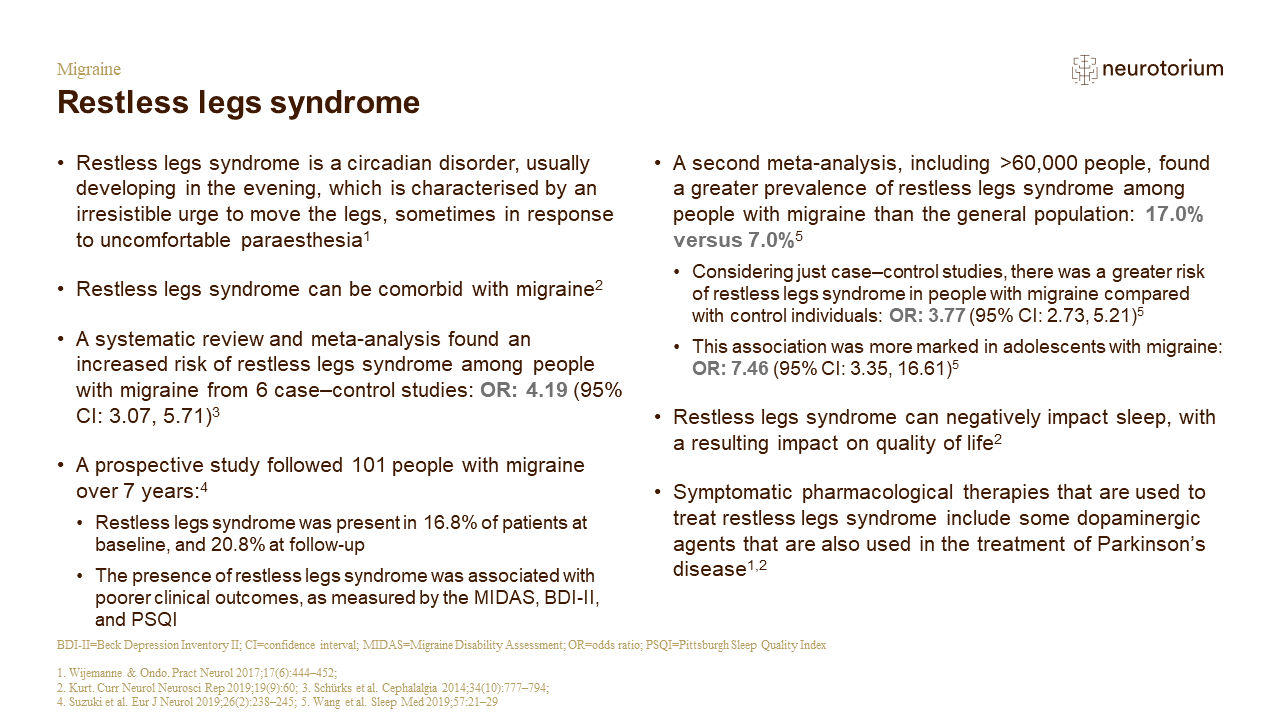
Part of the difficulty associated with the diagnosis and management of restless legs syndrome is that patients can sometimes struggle to articulate the condition.[Wijemanne & Ondo, 2017] Patients use a variety of different words to describe paraesthesia (an abnormal sensation often caused by pressure or damage to nerves), and may not immediately recognise the urge to move the legs, which is sometimes experienced as anxiety or inner restlessness.[Wijemanne & Ondo, 2017]
The connection of migraine and restless legs syndrome is a good example of the interconnectedness of comorbidities: migraine and restless legs syndrome are thought to be comorbid, as shown on the slide; migraine is also commonly comorbid with sleep disorders; restless legs syndrome reduces the quality of sleep; and, finally, poor sleep is thought to be a migraine trigger in some people.[Kurt, 2019] Unravelling this web of causality is not straightforward.
Other references used on slide:
Schürks M, Winter A, Berger K, Kurth T. Migraine and restless legs syndrome: a systematic review. Cephalalgia 2014; 34 (10): 777–794.