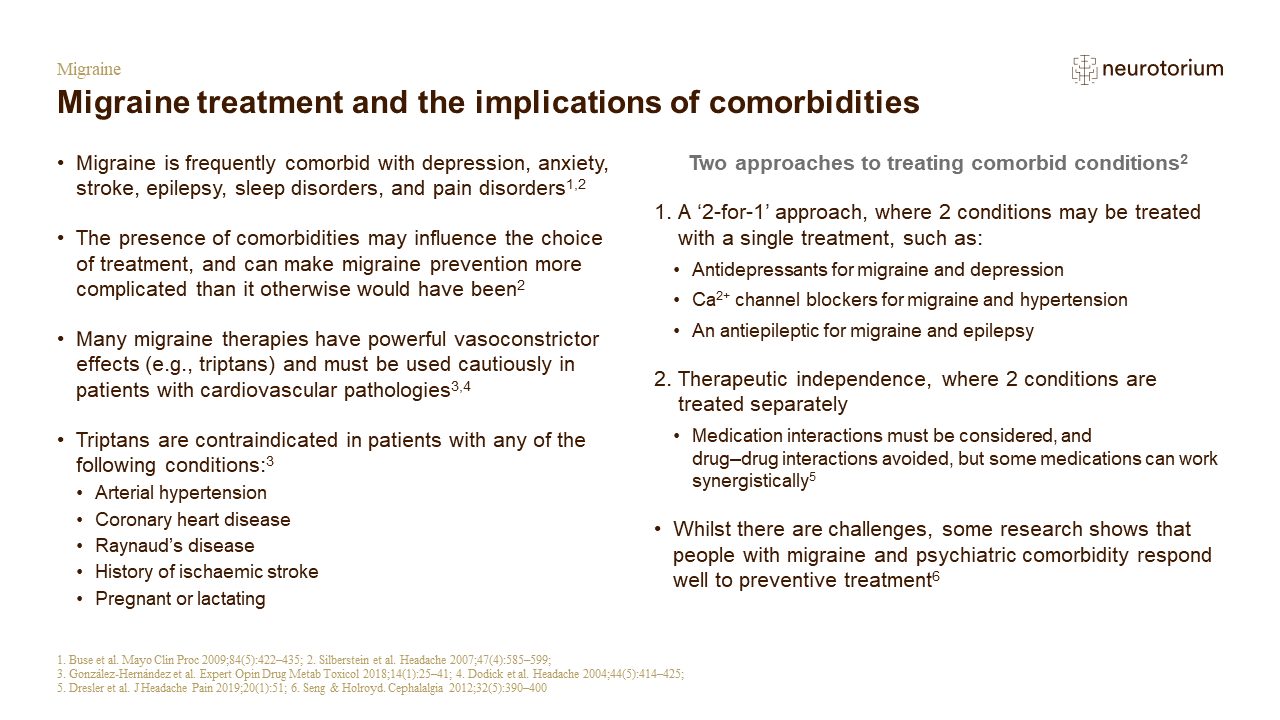
When considering treatment for a person with migraine and comorbid conditions, there are several risks to consider:[Silberstein et al., 2007]
- that only one of the conditions will be adequately treated – if a single medication is chosen to treat both conditions, as discussed on the slide, the doses required for each condition may be different
- that a suboptimal medication will be chosen, in an effort to use a single pharmacotherapy, overlooking a more optimal approach
- that pharmacotherapy will be poorly tolerated because of a third comorbid illness, or a pre-existing condition
- that the migraine and the comorbidity will respond to therapy at a substantially different speed. This requires different timelines to be considered when gauging the efficacy of an intervention on both the migraine and the comorbidity.
Reference:
Silberstein SD, Dodick D, Freitag F, et al. Pharmacological approaches to managing migraine and associated comorbidities – clinical considerations for monotherapy versus polytherapy. Headache 2007; 47 (4): 585–599.
Other references used on slide:
Buse DC, Rupnow MFT, Lipton RB. Assessing and managing all aspects of migraine: migraine attacks, migraine-related functional impairment, common comorbidities, and quality of life. Mayo Clin Proc 2009; 84 (5): 422–435.
Dodick D, Lipton RB, Martin V, et al. Consensus statement: cardiovascular safety profile of triptans (5-HT1B/1D agonists) in the acute treatment of migraine. Headache 2004; 44 (5): 414–425.
Dresler T, Caratozzolo S, Guldolf K, et al.; European Headache Federation School of Advanced Studies (EHF-SAS). Understanding the nature of psychiatric comorbidity in migraine: a systematic review focused on interactions and treatment implications. J Headache Pain 2019; 20 (1): 51.
González-Hernández A, Marichal-Cancino BA, Maassen Van Den Brink A, Villalón CM. Side effects associated with current and prospective antimigraine pharmacotherapies. Expert Opin Drug Metab Toxicol 2018; 14 (1): 25–41.
Seng EK, Holroyd KA. Psychiatric comorbidity and response to preventative therapy in the treatment of severe migraine trial. Cephalalgia 2012; 32 (5): 390–400.