Images

Filter

search
image Image Anatomical diagram of the basal ganglia, including the substantia nigra, striatum, globus pallidus, and related brain regions involved in motor control.
The basal ganglia 

The basal ganglia regulate movement through dopaminergic input from the SNc to the striatum, modulating motor signals via direct and indirect pathways.

04.06.2025 Parkinson’s Disease
image Image Illustration of dopamine’s action on D1 and D2 receptors in the striatum, showing how it excites or inhibits motor pathways via postsynaptic neurons.
Dopamine’s action on receptors in the striatum 

Dopamine modulates movement by acting on D1 and D2 receptors in the striatum, influencing excitatory and inhibitory motor pathways.

04.06.2025 Parkinson’s Disease
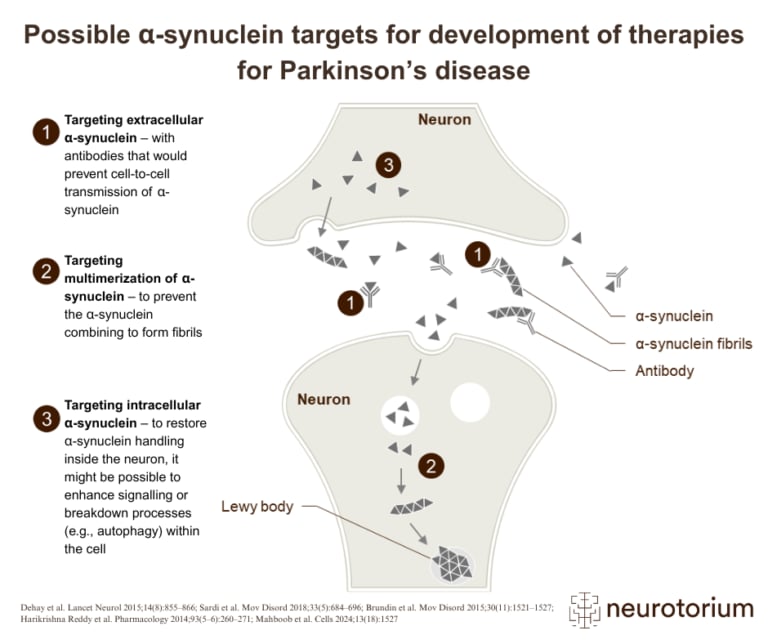
image Image Diagram showing the progression of α-synuclein in Parkinson’s disease, from monomers to aggregates, fibrils, and finally Lewy bodies.
α-synuclein 

α-synuclein plays a central role in Parkinson’s disease, progressing from monomers to fibrils and Lewy bodies — the pathological hallmark of PD.

04.06.2025 Parkinson’s Disease
image Image Illustration of α-synuclein protein deposits in multiple organs outside the brain in Parkinson’s disease, including the skin, stomach, colon, and salivary glands.
Multi-organ α-synuclein deposits in Parkinson’s disease 

Parkinson’s disease pathology extends beyond the brain, with α-synuclein deposits found in organs like the skin, stomach, colon, and salivary glands.

04.06.2025 Parkinson’s Disease
image Image Illustration of the autonomic nervous system pathways involved in the spread of α-synuclein in Parkinson’s disease, including the vagus nerve, brainstem, and organs.
The autonomic nervous system in the spreading of α-synuclein 

The spread of misfolded α-synuclein through the autonomic nervous system is central to the progression of Parkinson’s disease pathology

04.06.2025 Parkinson’s Disease
image Image Diagram showing how genetic factors, non-genetic factors, and epigenetic mechanisms interact to alter LRRK2 activity and contribute to Parkinson’s disease.
The aetiology of Parkinson’s disease

The development of Parkinson’s disease involves both genetic and non-genetic factors, including epigenetic mechanisms that influence LRRK2 activity.

04.06.2025 Parkinson’s Disease

No results matched your search.
Please try again.

task_alt