

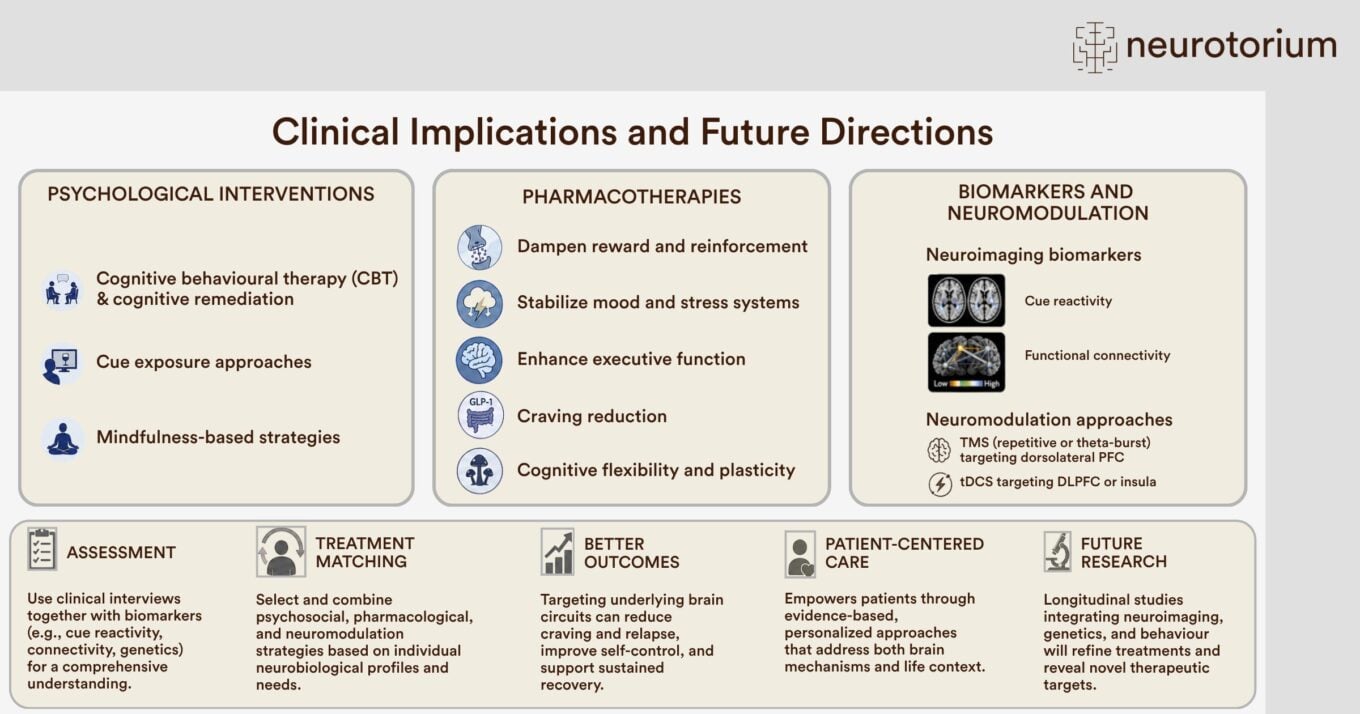
Recognition of addiction as a disorder of distributed brain circuits provides a framework for personalized assessment and treatment of addiction.
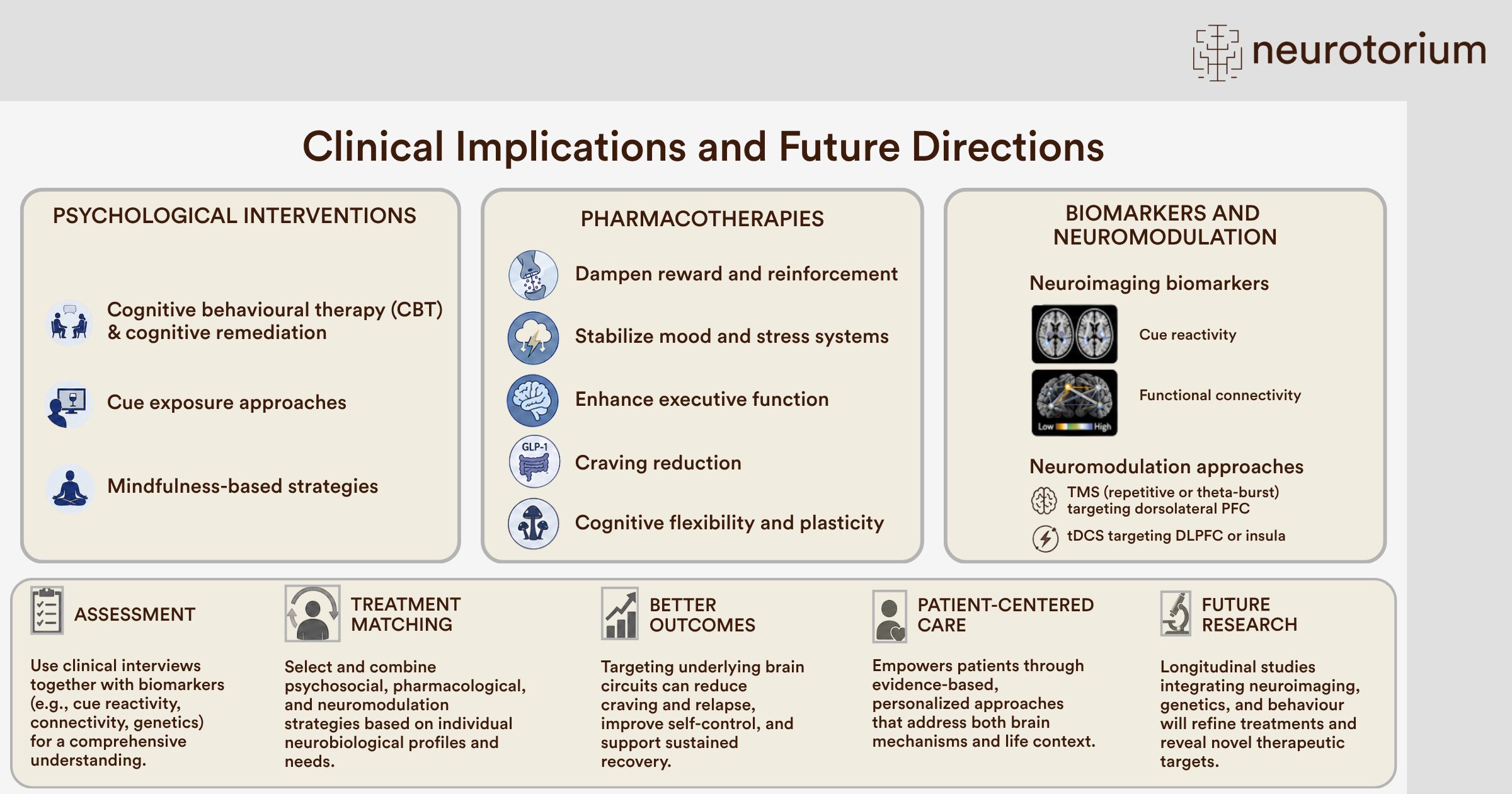
Psychosocial interventions aim to weaken conditioned cue–drug associations, improve executive function, and strengthen top-down control through plasticity within frontostriatal and limbic circuits.
Established pharmacotherapies target complementary neurobiological mechanisms by reducing reward-related reinforcement, stabilizing stress and affective systems, or enhancing executive control.
Emerging approaches include GLP-1 receptor agonists, which may reduce craving and reward-driven behaviour, and psychedelic-assisted therapies, which may promote cognitive flexibility and adaptive neural plasticity.
Neuroimaging biomarkers are being investigated to predict treatment response and relapse risk, whereas neuromodulation techniques, including transcranial magnetic stimulation (TMS) and transcranial direct current stimulation (tDCS), seek to enhance cognitive control.
Related content
Current evidence on the neurobiology of addictive behaviour highlights the transition from reward-driven to habitual drug use through alterations in mesolimbic dopamine, glutamatergic signalling, frontostriatal circuitry, and stress-related systems.
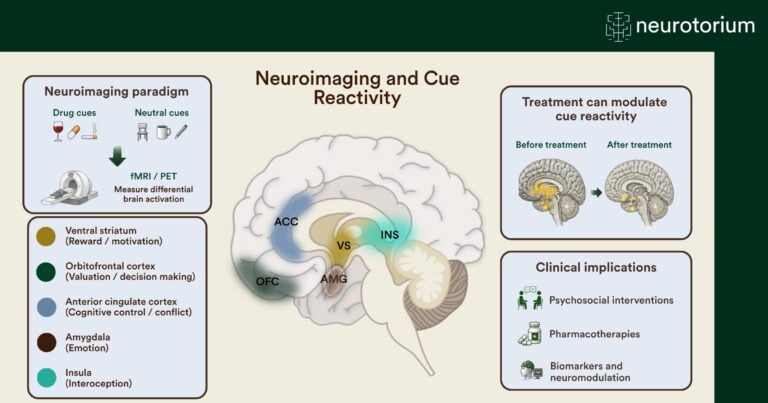
Functional neuroimaging studies commonly compare brain responses to substance-related cues versus neutral cues during fMRI or PET scanning and measure differential brain activation.
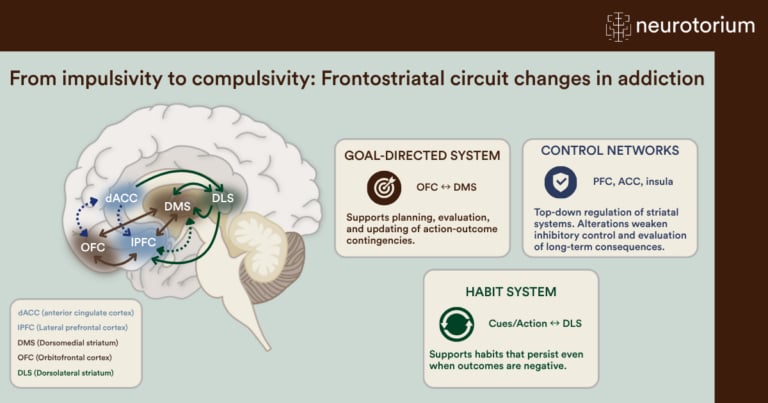
Repeated drug exposure shifts behavioural control from goal-directed, reward-driven actions mediated by orbitofrontal cortex (OFC)–dorsomedial striatum (DMS) circuits toward habitual and compulsive responding supported by the dorsolateral striatum (DLS).