

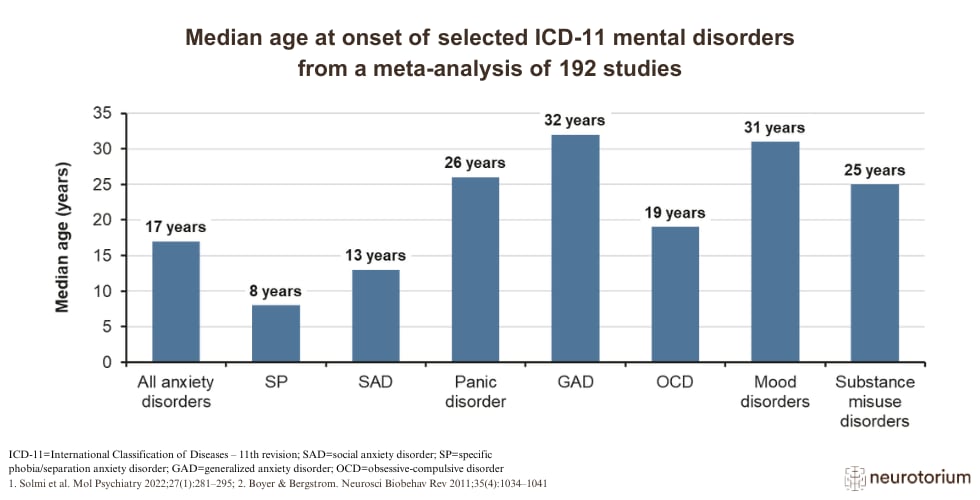
Specific targets of fear and anxieties (e.g., strange people, other animals, contaminants) emerge at specific stages of development, and their order of appearance is surprisingly stable among children from vastly different social and cultural environments, ranging from nomadic tribes to large cities.2
The results of this meta-analysis are consistent with an evolutionary view of anxiety as a normal adaptive response, with different threats at different stages of life.2
ICD-11=International Classification of Diseases – 11th revision; SAD=social anxiety disorder; SP=specific phobia/separation anxiety disorder; GAD=generalized anxiety disorder; OCD=obsessive-compulsive disorder
Related content

Decades of twin and family research have established that anxiety disorders run in families and are meaningfully influenced by genetic factors. Family and twin studies suggest an increased recurrence risk for first degree relatives of patients with anxiety to develop any anxiety disorders.
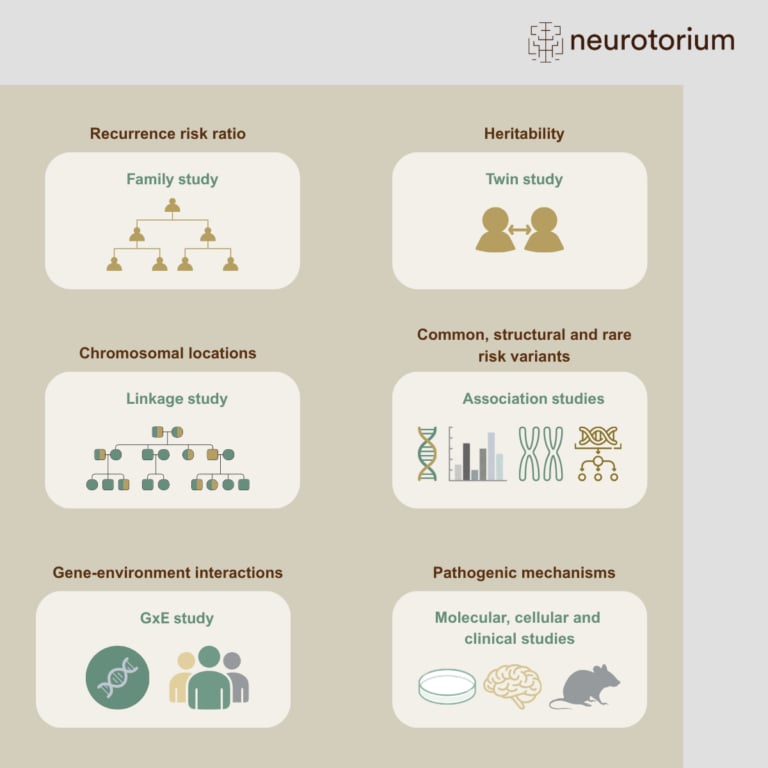
Family and twin studies estimate recurrence risk and heritability, showing that anxiety disorders aggregate in families and have a moderate genetic component.
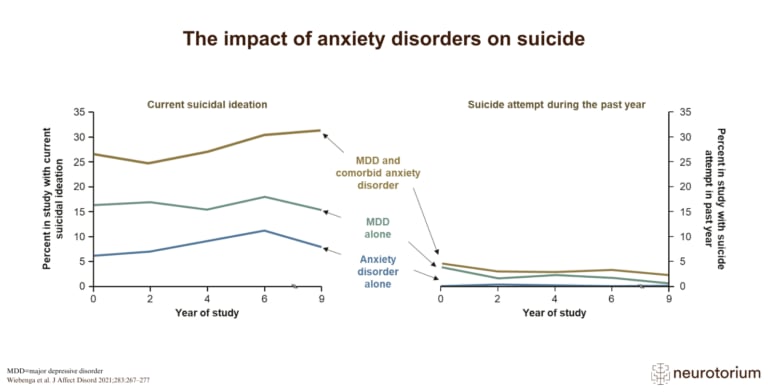
Suicidal ideation is far more common than attempts in people with anxiety or depression, especially with comorbid disorders and severe depression.