

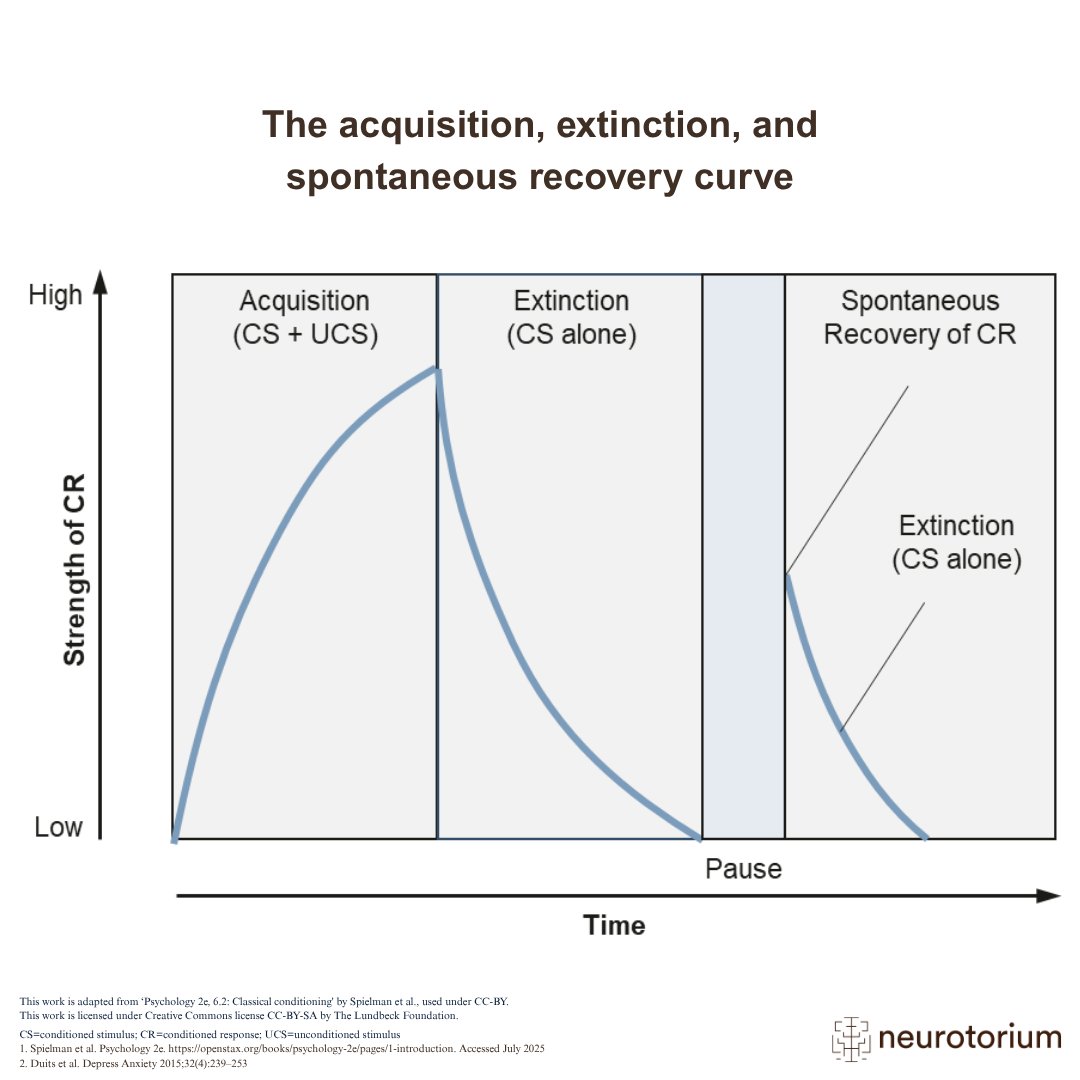
The rising curve in the graph represents the conditioned response becoming stronger through repeated association of the conditioned stimulus and the unconditioned stimulus, after which the strength weakens during the extinction phase when only the conditioned stimulus is presented.1 The spontaneous recovery describes how, after a pain in time, the conditioned response may reappear.1
Human studies of threat conditioning and fear learning2:
- A positive conditioned stimulus (CS+) is paired with an aversive unconditioned stimulus.
- A negative conditioned stimulus (CS-) is not paired with the aversive cue, and acts as a safety cue.
- Eventually, a conditioned response occurs where the positive conditioned stimulus evokes the same fear response as the aversive stimulus.The extinction of this response occurs over time on exposure to the newly conditioned stimulus in the absence of the aversive stimulus.
- However, the association between the CS+ and the aversive stimulus is not removed during extinction, but is replaced with a newly learned association that is now dependent on context.
CS=conditioned stimulus; CR=conditioned response; UCS=unconditioned stimulus
Related content
Decades of twin and family research have established that anxiety disorders run in families and are meaningfully influenced by genetic factors. Family and twin studies suggest an increased recurrence risk for first degree relatives of patients with anxiety to develop any anxiety disorders.
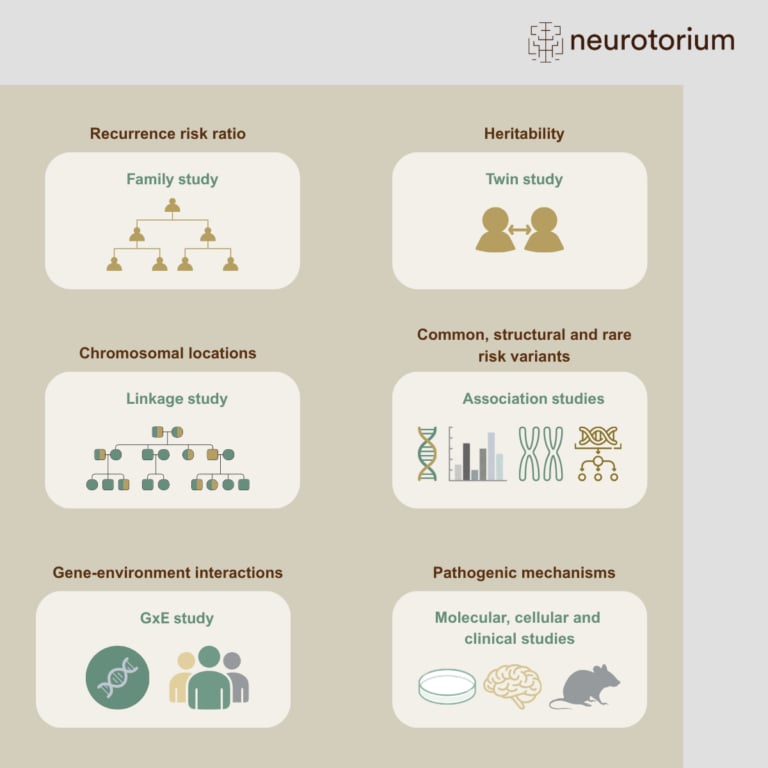
Family and twin studies estimate recurrence risk and heritability, showing that anxiety disorders aggregate in families and have a moderate genetic component.
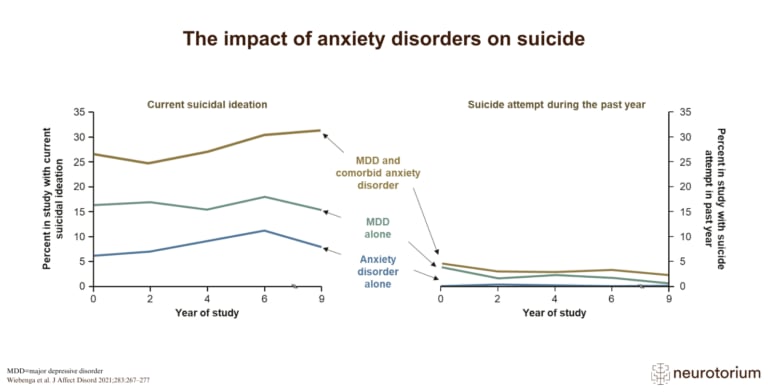
Suicidal ideation is far more common than attempts in people with anxiety or depression, especially with comorbid disorders and severe depression.